January 21, 2026
Durable CDR Global Policy Review | January 2026 Update
Where and When Will Durable CDR Become a Compliance Market?
Highlights
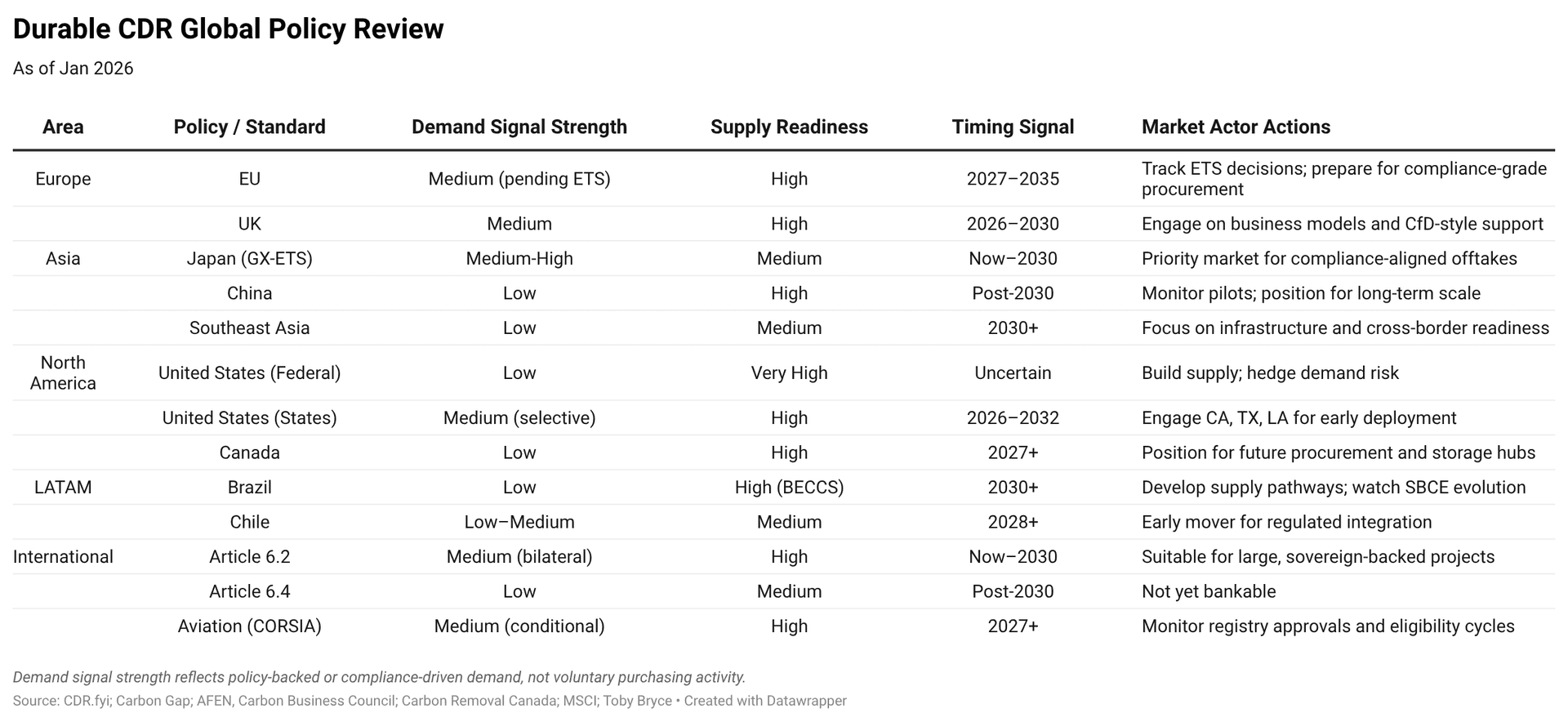
- Policy Momentum: Durable CDR is now explicitly referenced across major climate policy frameworks, including the EU, UK, Japan, and aviation, but policy progress remains uneven and fragmented, creating uncertainty around when and how demand will materialize.
- Demand Gap: Voluntary demand continues to grow but remains highly concentrated among a small number of buyers, falling well short of the broad-based, predictable demand required to scale durable CDR toward the hundreds of millions of tonnes per year needed by the 2040s.
- Compliance Takes Shape: Japan is the clearest near-term compliance pathway (GX-ETS transitions from voluntary to mandatory from 2026, with eligible credits depending on what qualifies under linked schemes), while the UK is targeting ETS integration by 2029 and the EU is assessing inclusion for ETS Phase V; aviation is advancing removals through CORSIA, while other regions are moving more slowly or facing political retrenchment.
- Supply Ahead: Across most regions, policy and investment are accelerating supply readiness, infrastructure, and certification faster than binding demand mechanisms, increasing financing risk for developers and slowing infrastructure-scale deployment.
- Alignment is the Constraint: Scaling durable CDR will require coordinated action from corporates, standards bodies, and policymakers to convert policy recognition into credible, bankable demand signals across major economies within the next five years.
How to Read this Global CDR Policy Review
This review focuses on where durable CDR is most likely to translate into bankable demand through compliance-linked pathways, including ETS eligibility, regulated procurement, and bilateral accounting (Article 6). We assessed markets based on regulatory readiness, political durability, and the likelihood of translating policy recognition into financeable demand signals for suppliers and purchasers.
In this roundup, “compliance-linked demand” includes (i) formal ETS eligibility, (ii) regulated public procurement, and (iii) internationally transferred mitigation outcomes under Article 6 with corresponding adjustments.
Note: Compliance is not the only lever shaping durable CDR. We also flag government procurement (e.g., CfDs and reverse auctions), permitting and storage access, industrial carbon-pricing design, and reporting/claims standards where they materially affect market timing.
Please note, that this blog article is an abridged version of the CDR.fyi Durable CDR Global Policy Review, which includes analysis of country-level frameworks, regulatory updates, and key stakeholder contributions.
👉 Sign up through the pop-up form in the blog article to receive the full Global Policy Review.
Acknowledgments
CDR.fyi expresses its sincere gratitude to the following organizations and individuals for their contributions of analysis, technical review, or regional expertise to specific sections of this report. Their input helped improve accuracy and completeness. Responsibility for synthesis, interpretation, and conclusions rests with CDR.fyi.