Purpose and Scope of this Guide
As CDR becomes an essential component of credible net-zero strategies, many organizations are seeking guidance on how to engage with the CDR market in a way that is informed, responsible, aligned with regulatory expectations, and integrated into long-term climate plans. The purpose of this Guide is to provide a clear, neutral, and practical framework to support organizations that are considering — or already — planning to purchase CDR credits. Accordingly, this Guide focuses specifically on the considerations involved in purchasing CDR credits, and does not provide guidance on insetting or direct project development.
We acknowledge the useful contributions of other CDR buyer resources, including those from Frontier, Microsoft and Carbon Direct, Milkywire, Carbonfuture, the South Pole and WBCSD guidance, and Isometric's buyer's guide to biochar which offers a more method-specific perspective on biochar procurement. Each offers valuable insights into specific parts of the procurement process. This Guide builds on those efforts by bringing the full CDR procurement journey into an end-to-end, practical, and method-agnostic framework. A curated list of external references is included in Appendix B for readers who wish to explore these materials in more detail.
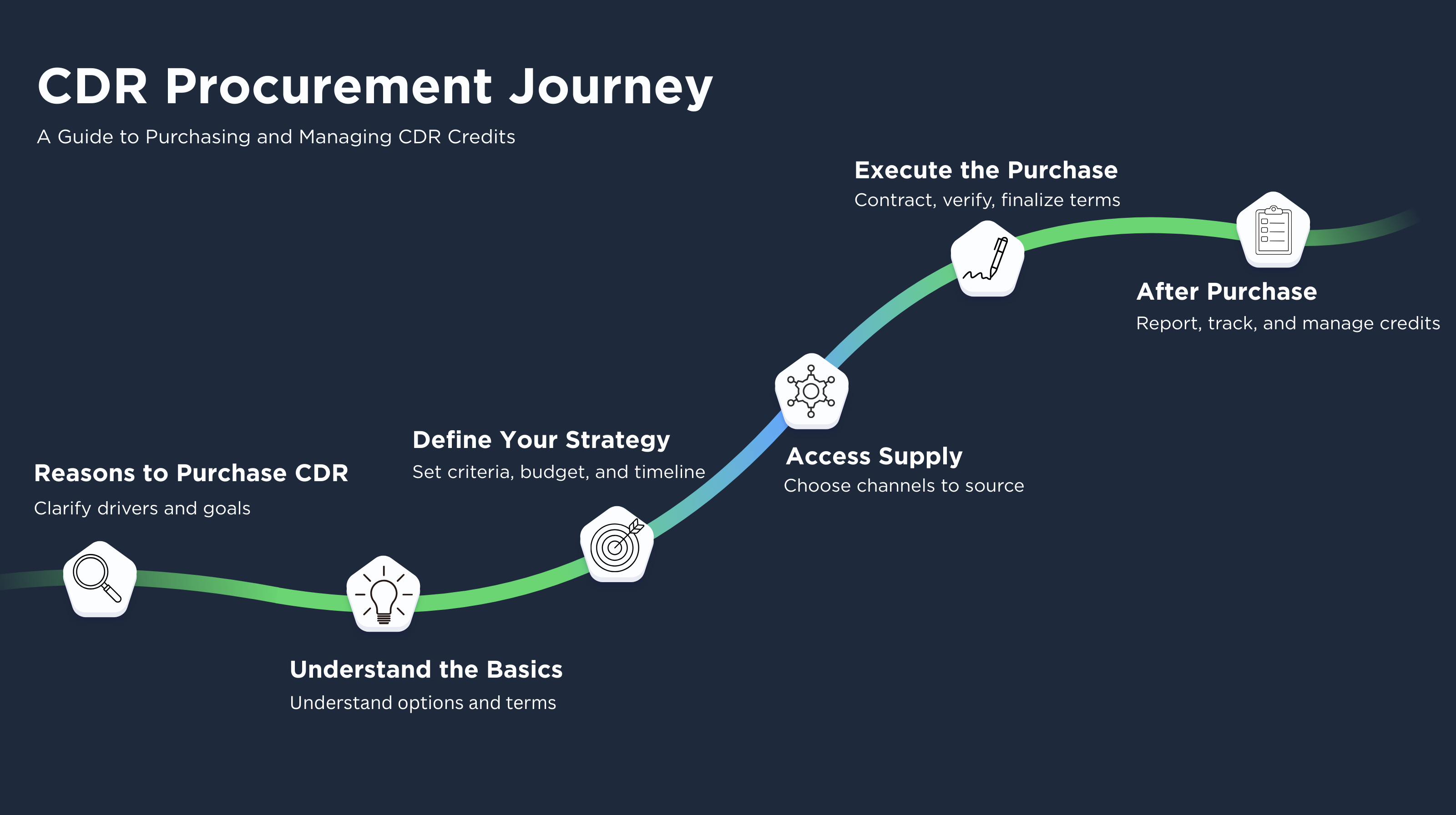
This Guide follows the full CDR procurement journey from start to finish. It begins by outlining the reasons why organizations may choose to engage with CDR. It then introduces the basics needed to navigate the market. Building on this foundation, the Guide explains how to define a purchase strategy, access supply through different procurement channels, execute the purchase through contracting, and report on and manage CDR credits after delivery. Its goal is to equip buyers with clear, neutral, and practical guidance that is aligned with climate science, emerging regulation, and best practices in transparency and integrity.
The scope of the Guide is intentionally technology-neutral and supplier-neutral. It does not promote specific projects, developers, or methods, nor does it rank CDR methods. Instead, it explains the considerations, trade-offs, and quality signals that matter across all methods. Where appropriate, it highlights commonly used tools, standards, and reference frameworks to support credible procurement.
This Guide is intended for a broad range of organizations engaging with CDR. It is especially relevant for sustainability leaders developing or implementing net-zero strategies, teams exploring whether and how to begin purchasing CDR, and current carbon removal purchasers seeking a structured, high-integrity approach to procurement. While applicable to all market participants, the Guide is also designed to support organizations that may lack extensive internal technical, procurement, or contracting expertise, offering a clear and accessible starting point for engaging with the CDR market.