CDR Characteristics
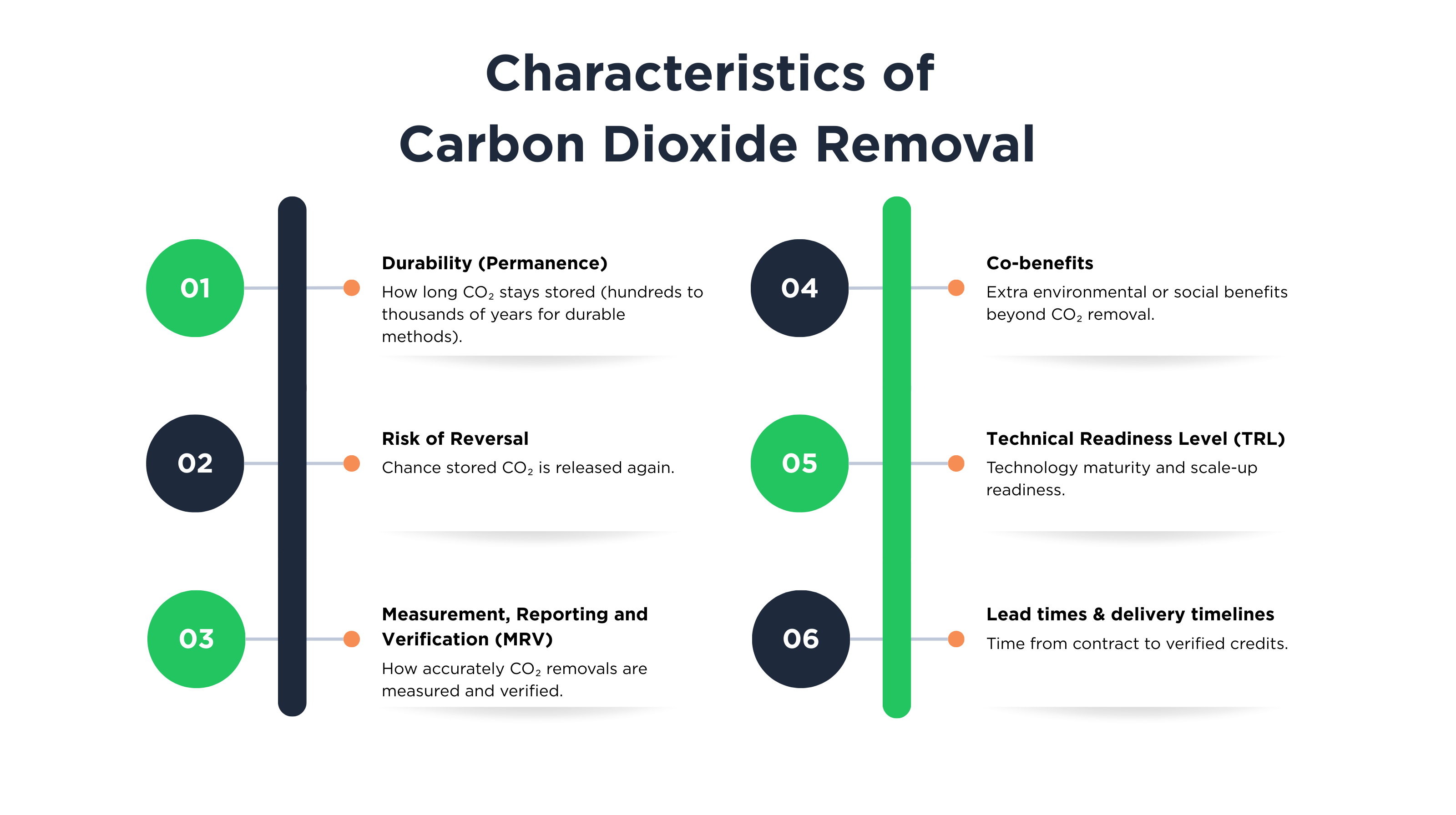
Durability (Permanence): Durability describes how long the removed CO₂ remains out of the atmosphere before it could potentially return. It is determined by the storage medium and the physical or biochemical processes governing carbon stability. Durability influences how credits can be used in long-term climate strategies and whether they align with guidance such as the Oxford Offsetting Principles. While thresholds vary across standards and policy frameworks, durable CDR methods typically offer storage of hundreds to thousands of years.
Risk of Reversal: Reversal risk refers to the likelihood that stored carbon is re-emitted to the atmosphere. Some methods carry physical or ecological risks (e.g., fire, pests, erosion), while others store carbon in geologic or mineral forms with negligible reversal risk. Understanding these risks is essential for choosing appropriate methods and interpreting permanence guarantees or buffer mechanisms.
Measurement, Reporting and Verification (MRV): MRV describes the scientific accuracy and uncertainty associated with quantifying removed CO₂. MRV robustness differs across methods. Engineered removals often have precise measurement systems, while nature-based methods may involve higher uncertainty or complex monitoring requirements. MRV quality directly influences credit credibility and reporting accuracy. See MRV Process for a further explanation of the MRV process.
Co-benefits: Additional positive environmental or social effects generated by a CDR project beyond carbon removal itself. Nature-based solutions may deliver ecological or social co-benefits, while some engineered methods have fewer co-benefits but lower land-use impacts. Co-benefits can be relevant for corporate sustainability objectives but should not replace rigorous MRV and durability assessment.
Technical Readiness Level (TRL): Describes the maturity of a CDR method. CDR methods vary from mature technologies with megaton-scale deployment potential to emerging solutions with early-stage MRV and uncertain scale-up trajectories. These differences matter for long-term planning and price expectations.
Lead times & delivery timelines: Period between contracting a CDR project and receiving verified CDR credits. Some methods deliver quickly (e.g., biochar), while others require multi-year development (e.g., Direct Air Carbon Capture and Sequestration (DACCS), Bioenergy with Carbon Capture and Sequestration (BECCS)).