Standards and MRV
Integrity is central to any CDR purchase. Regardless of the method chosen, buyers must ensure that credits come from high-quality, verifiable, and transparent projects. This requires understanding the key components of the CDR certification framework — from standards and methodologies to verification and registries — and how they combine to form a credible MRV (Monitoring, Reporting, and Verification) process. The following terms are foundational to this framework:
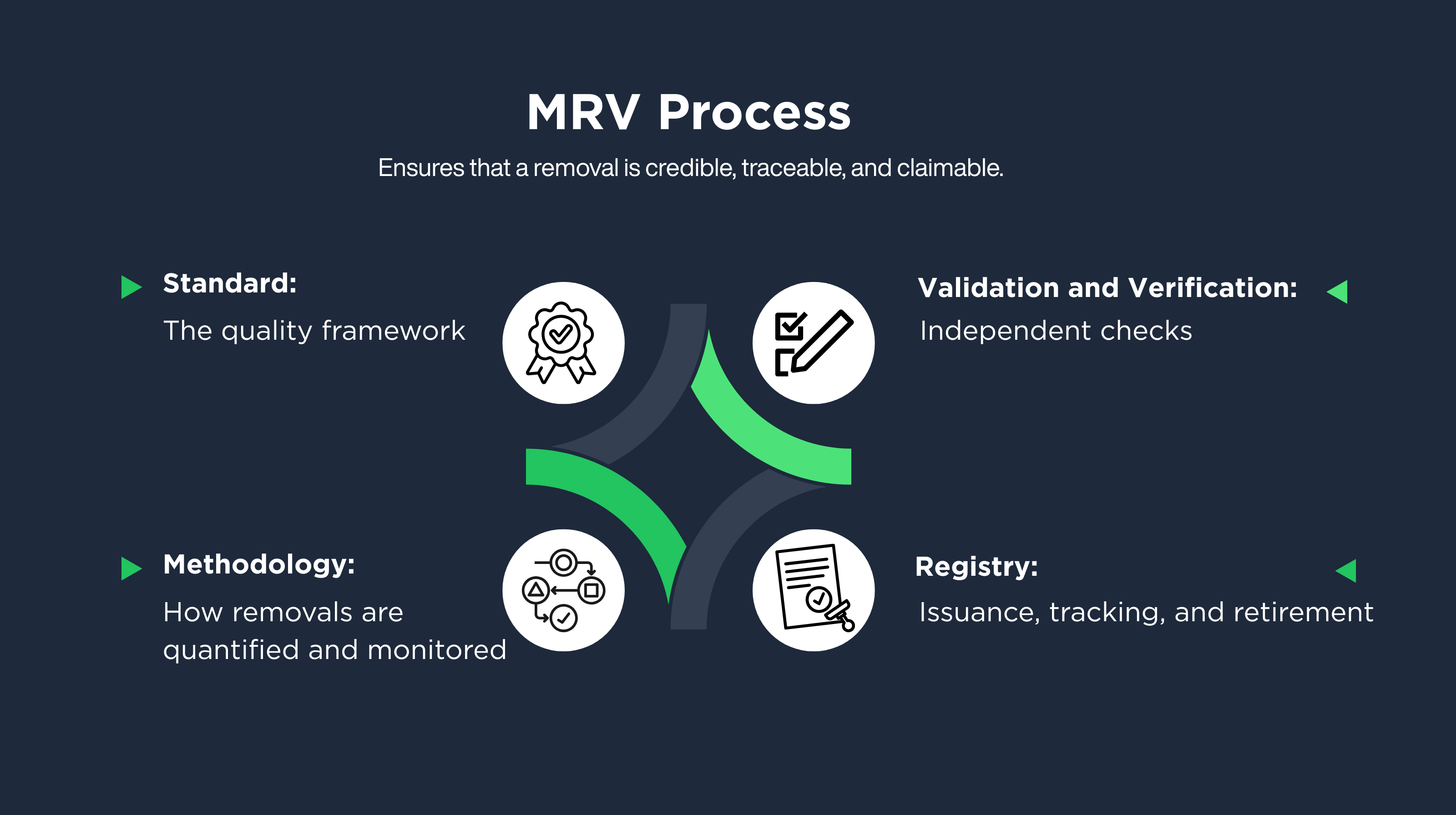
Standard (The quality framework)
A standard defines the overarching integrity requirements that all certified projects must meet, including durability thresholds, MRV expectations, additionality rules, and verification procedures.
Standards such as Puro.earth, Isometric, Verra, and Gold Standard set these criteria and approve methodologies used by individual CDR methods. See CDR.fyi's article for a clear overview.
Beyond individual standards, higher-level integrity frameworks — such as the ICVCM Core Carbon Principles — evaluate whether standards themselves meet a credible minimum bar for integrity. See Which? for how to apply these tiers when evaluating specific projects.
Methodology (How removals are quantified, monitored, and reported)
A methodology provides the detailed, method-specific instructions for quantifying carbon removal, monitoring storage over time, and assessing risks.
Crucially, a methodology defines:
System boundary – What emissions and removals are included in the accounting. This determines which parts of the value chain are measured (e.g., feedstock sourcing, transport, energy use, downstream storage) and ensures that all relevant emissions within the project scope are accounted for.
Baseline – The counterfactual scenario representing what would have happened in the absence of the project. Credited removals are calculated relative to this baseline, making it central to additionality and net removal claims.
Each CDR method (e.g., DACCS, biochar, afforestation) uses a methodology approved by a standard. See the figure in the CDR.fyi's article for additional explanation and a helpful figure showing methodological maturity across CDR methods.
Validation and Verification (Independent checks)
Accredited third-party verifiers assess whether the project design adheres to the approved methodology (validation) and whether the reported removals actually occurred (verification).
Registry (Issuance, tracking, and retirement)
Once verified, removals are issued as credits on a registry (e.g., Puro Registry, Isometric Registry, Verra Registry). Registries assign unique serial numbers, ensure credits cannot be double-counted, and track transfers between parties. A credit can only be used for claims once it is retired on the registry. Retirement marks the credit as permanently used and prevents further trading or reuse.
Note that many standards operate their own registry — which is why organisations like Puro.earth, Isometric, and Verra appear in both contexts: as the standard setting the rules, and as the registry issuing and tracking the credits.
How MRV Works in Practice: The Credit Lifecycle
To make these components operational, it is helpful to view MRV as a structured lifecycle:
-
Project registration – The developer submits a project design under an approved methodology to a recognized standard.
-
Validation – An independent validator confirms that the project design complies with the methodology and standard.
-
Monitoring & reporting – The developer measures actual removals and compiles monitoring reports.
-
Verification – An independent verifier audits the reported removals.
-
Issuance – Verified tonnes are issued as credits on a registry.
-
Retirement – The buyer retires the credit to make a legitimate climate claim.