Which?
There is no one-size-fits-all solution when selecting CDR methods. Different buyers may favor different CDR methods depending on their objectives, priorities, and constraints. However, a few common considerations can help guide decisions from general principles to more specific choices.
Part 1: Selecting a CDR method
Opt for durable removal methods
Durable methods—those storing carbon for hundreds to thousands of years—are ultimately required to neutralize residual emissions and limit climate overshoot. As a result, methods such as direct air capture with storage (DACCS), bioenergy with carbon capture and storage (BECCS), biochar, or carbon mineralization should be prioritized over shorter-duration approaches such as afforestation and reforestation, particularly for long-term net-zero strategies.
Within durable methods, prioritize robust MRV and integrity
Among durable methods, buyers should favor those with clearer carbon accounting, established methodologies, and lower uncertainty. MRV maturity varies significantly across CDR methods — some, such as biochar and direct air capture, have relatively established measurement frameworks, while others, such as enhanced weathering or ocean-based removal, are still developing the scientific and methodological foundations needed for high-confidence accounting. Favoring methods with more mature MRV reduces integrity risk, even before evaluating individual projects.
For an overview of the standards and MRV process that underpin CDR integrity, see Standards and MRV.
Consider a portfolio approach to balance costs
Buyers may choose to combine higher-cost, highly durable removal methods with more readily available and lower-cost options as a way to manage overall procurement costs. A portfolio approach can also help diversify delivery risk across different CDR methods.
Part 2: Evaluating specific projects and suppliers
Once a buyer has identified the CDR method or methods they wish to pursue, the next step is evaluating specific projects and suppliers. This is a different level of analysis — moving from method selection to project-level due diligence. Buyers can conduct this assessment internally or rely on support from external organizations — such as consultancies, marketplaces, or specialized intermediaries. Regardless of who performs the assessment, due diligence should help ensure that a project is credible, financially resilient, and capable of delivering carbon removals over time. The following five categories offer a practical, streamlined checklist to guide this process.
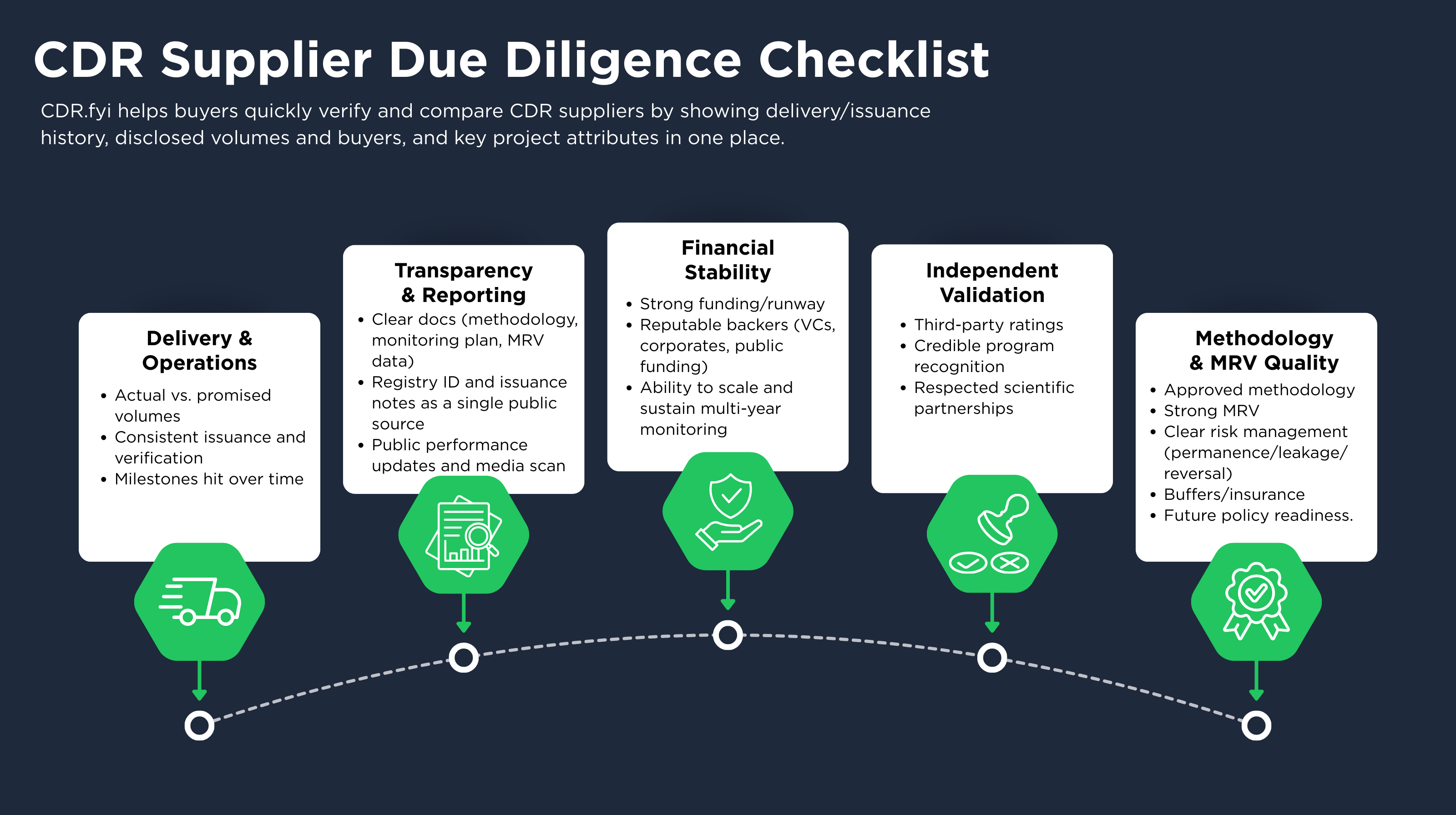
Methodological robustness & MRV quality
Methodologies and MRV frameworks are central to CDR integrity, but they are also evolving in practice. Standards continue to develop, interpretations can differ across verifiers, and projects applying the same protocol may still vary meaningfully in quality. Buyers should therefore view MRV not as a static checklist, but as an area requiring informed judgment and ongoing scrutiny. When assessing methodological robustness and MRV quality, buyers should consider:
- Standards (first tier): Whether the project applies a methodology approved by a recognized standard — such as Puro.earth, Isometric, Verra, or Gold Standard. This is the baseline filter: a project without recognized standard backing warrants significant additional scrutiny (check cdr.fyi diagram)
- Higher-level integrity frameworks (second tier): Whether the standard itself has been assessed against broader quality frameworks. The most notable example is the Integrity Council for the Voluntary Carbon Market Core Carbon Principles (CCPs), which evaluate whether carbon-crediting programs meet a credible minimum bar for integrity. Credits issued under CCP-eligible programs provide an additional layer of assurance.
-
The strength and transparency of the MRV (measurement, reporting, verification) approach: The clarity of measurement approaches, data availability, monitoring frequency, and the independence and rigor of verification
-
Treatment of key risks: How permanence, leakage, and reversal risks are identified, quantified, and managed, including the use of buffers or insurance mechanisms where applicable
-
Capacity to improve over time: Whether the developer demonstrates openness and capability to strengthen MRV practices as standards evolve. In practice, improvements or revisions to MRV approaches—when they increase rigor and transparency—should generally be viewed positively
-
Readiness for policy recognition: The extent to which methodologies and MRV practices are likely to align with emerging policy frameworks (e.g., CRCF, Article 6, CORSIA), recognizing that requirements may tighten over time
Market sources like cdr.fyi can help compare methodology adoption, issuance history, and durability profiles across suppliers
Delivery track record & operational performance
A developer's ability to deliver what they sell is one of the strongest indicators of integrity. Buyers should assess:
- Delivery vs. sales performance (actual vs. promised volumes)
- Consistency of issuance and verification
- Operational milestones achieved over time
Useful data can be found in public project documentation and market data sources such as cdr.fyi, which track issuance, delivery, and buyer activity across CDR suppliers.
Transparency & reporting quality
High-integrity developers are transparent and provide accessible, high-quality information. Look for:
-
Clear project documentation (methodology used, monitoring plans, MRV data)
-
Registry records and issuance notes: Project developers are generally required to publish their documentation on the registry they use, enabling buyers to clearly reference the project, its unique ID, and a single public source for all disclosed project information.
-
Publicly available performance updates
-
News coverage and media review to identify any potential controversies or integrity concerns associated with the supplier(s)
cdr.fyi can support this assessment by highlighting which developers publicly disclose volumes, buyers, and delivery status.
Financial stability & long-term viability
Because many CDR projects require multi-year delivery and ongoing monitoring, buyers should evaluate the developer's financial health:
- Funding sources and financial runway
- Backing by reputable investors (VCs, corporates, public funding)
- Financial statements or disclosures (when available)
- Ability to scale operations over time
Financially resilient developers are more likely to meet long-term monitoring and verification commitments.
Independent validation & market recognition
External perspectives can strengthen confidence in a developer's credibility. These signals include:
- Independent project ratings (e.g., BeZero, Sylvera, Calyx Global)
- Participation or recognition in reputable programs (e.g., XPRIZE, Elemental Excelerator, Remove)
- Collaborations with scientific partners or research institutions (e.g., Cascade Climate, Carbon to Sea)